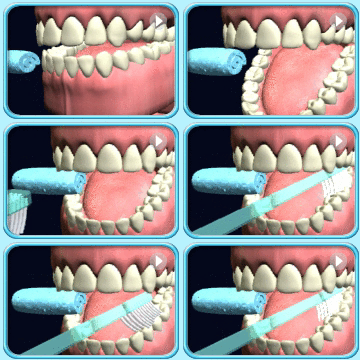
Clean the teeth
People with special needs should also learn toothbrushing techniques. However, they need to be taught individually through a longer period of time with repetitive practices in order to master the techniques. Parents and nurses need to assist them before they can completely master the techniques in toothbrushing.
Assisting people with special needs to brush
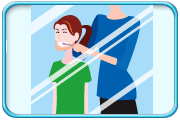
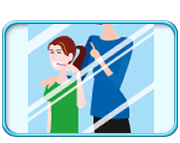
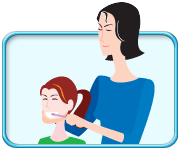
First, let him/her face a mirror with you standing behind him/her. Using one hand to support his/her chin, and the other hand to help him/her brush.
If he/she can hold his/her own toothbrush, let him/her brush on his/her own. You need to supervise, observe and correct his/her brushing technique.
Possible difficulties encountered when assisting people with special needs to clean their teeth
If the person doesn't know how to spit, it is difficult for him/her to rinse after toothbrushing.
You can first let him/her wear an apron to avoid getting his/her clothes wet. Prepare a glass of drinking water for him/her to rinse. When he needs to rinse, teach him/her to first open his/her mouth and then slowly pour the water into his/her mouth. Let the water flow out from his/her mouth so that the foam from toothpaste will be rinsed out from his/her mouth naturally.
Swallowing toothpaste while brushing
- Use only a pea-sized blob of toothpaste to brush his/her teeth. No harm will be done to his/her body even if he/she accidentally swallows the toothpaste. Fluoride is effective in preventing tooth decay and strengthening teeth, therefore it is essential that fluoride toothpaste is used. If you are worried that the fluoride content in toothpaste is too high, you might consider using children's fluoride toothpaste which contains only half of the fluoride content as the regular adult fluoride toothpaste.
Involuntary wobbling of the head
You may stand behind him/her, use one hand to wrap around his/her head, and gently support his/her chin to stabilize his/her head. Remember to do this only if he/she is willing, otherwise he/she will refuse to brush or floss his/her teeth.
Protruding tongue which interferes with toothbrushing
- Tongue protrusion during toothbrushing is a natural reflex. You may first ask him/her to calm down and start toothbrushing for him/her as soon as he/she relaxes his/her tongue. There is only a short period of time while he relaxes his/her tongue. Therefore you may need to precisely place the toothbrush inside his/her mouth and speed up the brushing process to make toothbrushing more pleasant for him/her. You may also consider using an electric toothbrush to shorten the time needed for brushing. However, you should use a correct brushing technique with care in order to avoid damaging his/her teeth and gum.
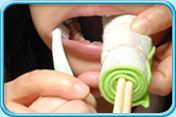
Biting on toothbrush
Being impatient
- You may start by brushing the easiest areas such as the outer surfaces. This can be done even if he/she is closing his/her teeth together. Then ask him/her to open his/her mouth so that you can brush the chewing surfaces and inner surfaces of his/her upper teeth. Finally, you can brush the inner surfaces of his/her lower teeth.
Refuse toothbrushing
- Find out the reason why he/she refuses to brush, then target at this reason to help him/her overcome his/her hard feelings towards brushing. If toothbrushing brings him/her discomfort, his/her gum may be sensitive due to gum inflammation. You may first choose a softer toothbrush and let him/her try to get used to brushing only a few teeth. After he/she gets used to brushing, you can then try to brush the rest of his/her teeth. Ask him/her to raise his/her hand when he/she feels uncomfortable and stop brushing to let him/her take a rest. It is important that you must not try to brush all his/her teeth by force. Otherwise, it will be difficult to change his/her attitude toward toothbrushing in the future.
Gagging when he/she brushes his/her teeth
- You may use a toothbrush with a smaller head. When you are brushing his/her molars, try not to place the toothbrush too far back as long as you can brush his/her last tooth in order to avoid gagging. If there are sensitive areas which make him/her gag, you should brush those areas last.
Crooked teeth which are difficult to clean
- You may use a toothbrush with a small head. Pay special attention to areas of irregularity to make sure that the bristles have touched the gingival margins. This could ensure that the teeth are thoroughly cleaned.
Difficulty in inserting the dental floss into the interproximal area (area between the teeth)
- Difficulty in inserting the dental floss into the interproximal area may be caused by the accumulation of calculus. The situation will improve once the calculus has been removed by the dentist. Remember to floss daily after the calculus has been removed in order to avoid accumulation again.