Tooth Club en_adu_01_top2.jpg en_adu_01_top3.jpg en_adu_01_top4.gif
en_adu_01_top5.jpg en_adu_01_03_01_07.gif en_adu_01_top7.jpg en_adu_01_top8.gif
Home en_adu_01_03_01_11.gif
Toothbrush Toothbrush
Function and method of use
Types of toothbrush
How to choose a toothbrush?
Toothbrush
Toothbrush
en_adu_01_01_01_13.gif
Knowing Your Teeth
Oral Care Tips
Toothbrush
Toothpaste
Dental Floss
Mouth Rinse
Tooth whitening
  agents
Denture Cleaning
  Tablets
Oral Care Products
Oral Diseases
Oral Problems
Oral Treatments
Oral Health Care during Pregnancy
Interactive Clinic
en_adu_01_01_01_24.gif en_adu_01_01_01_25.gif
  en_adu_01_01_01_27.gif en_adu_01_01_02_28.gif en_adu_01_01_01_29.gif
   
Manual toothbrush
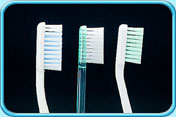
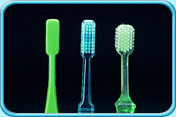
Shape of toothbrush head

Conventional


Conventional
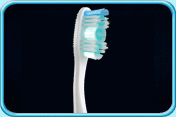
All conventional toothbrush head designs are effective in cleansing every tooth surface.


Diamond shape
The tips of these toothbrush heads are narrower than those of the conventional ones. These tips are designed for easy access to posterior teeth.

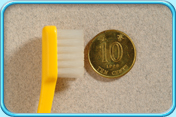
A toothbrush with any kind of brush head cleans teeth effectively. However, the size of the brush head should be considered according to the size of the oral cavity:
0-2 years


0-2 years
Brush head size should be approximately the diameter of a Hong Kong 10-cent coin (~15mm).


2-6 years
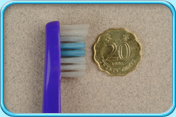
Brush head size should be approximately the diameter of a Hong Kong 20-cent coin (~19mm).

6-12 years


6-12 years
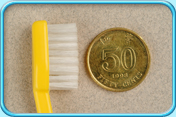
Brush head size should be approximately the diameter of a Hong Kong 50-cent coin (~22mm).

12 years and above


12 years and above
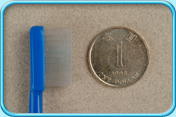
Brush head size should be approximately the diameter of a Hong Kong one-dollar coin (~25mm).
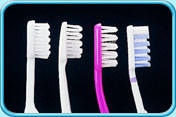
Bristle pattern


Block pattern
The bristles are of the same length and are arranged neatly like a block.


Wavy or V-shape pattern
The bristles form a V-shape or wavy pattern. According to the manufacturer, this is intended to give the bristles a better contact with the areas around the adjacent tooth surfaces.


Advantage
If these toothbrushes are used correctly, it is claimed by the manufacturer that their bristles will naturally be pointing at the gum line at a 45 degree angle. It is also suggested that since the bristles at the brush tip are longer, it enables the toothbrush to reach the difficult-to-clean areas.

In fact, any of the above brush head design can effectively clean the teeth. Nonetheless, the bristles must be soft. Thus, you can choose according to your personal preference.
Handle design

Straight handle


Straight handle
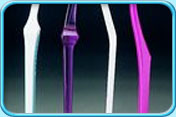
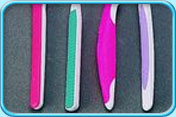
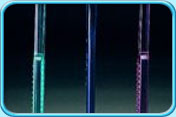
All conventional toothbrushes have straight handles that are easier to control.

Contra-angle handle


Contra-angle handle
This handle design is similar to a dental instrument, intending to access to the difficult to clean areas.

Flexible handle


Flexible handle
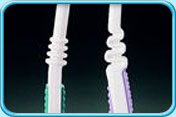
This kind of handle intends to reduce gum injury caused by excessive brushing force.

Slip prevention grip handle


Slip prevention grip handle
This handle intends to prevent the toothbrush from slipping away during toothbrushing.


None of the handle design possesses special tooth cleansing effect. You may make your choices according to your personal preference.


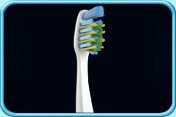
Powered Toothbrush
Mechanical motions of different brush heads


Brush head oscillates sideways, forwards and backwards.


Each tuft of bristles rotates individually.


The entire brush head rotates in clockwise and anti-clockwise direction.
Is it suitable for you?

People with special needs, such as the physically and mentally disabled, may choose to use powered toothbrushes.

The high oscillation/rotation speed of the powered toothbrush may cause injury to the teeth if it is not used correctly. The technique in using powered toothbrush is different from that of the manual toothbrush. You should consult your dentist to achieve an optimal cleansing effect with your powered toothbrush.

As powered toothbrushes are more expensive than manual toothbrushes, you may consider using it according to your financial capability.


Superbrush
Function
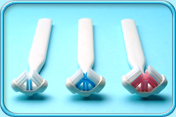
It is designed to simultaneously clean the outer, inner and chewing surfaces of teeth.
Function


Toothbrush head design
Three brush heads are combined together in the Superbrush. When the brush is placed on the chewing surface, all the three surfaces of the tooth are cleaned simultaneously. It shortens the brushing time.
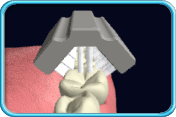
Three brush heads


Is Superbrush suitable for you?

User should have well aligned teeth.

It is suitable for parents and health care workers who have to brush the teeth for the children or disabled, or for those whose manual dexterity is inadequate.

The choice of toothbrush is a matter of personal preference. If you are interested in using the Superbrush, you can try it.



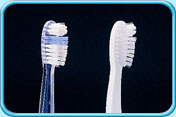
Single-tuft toothbrush

What is a Single-tuft toothbrush?

It is a toothbrush with a very small head which can be used to clean wisdom teeth and crooked teeth effectively. There are various shapes of the brush head. The cleansing effectiveness of different shapes of the brush head is the same.

Single-tuft toothbrush


Function and method of use
It is used to clean the areas which are unreachable by conventional toothbrush such as:


Wisdom teeth
Method of use:
Hold the brush in a pen grip, and place the bristles at the gum margin of the wisdom tooth and brush gently to clean every tooth surface.


Crooked teeth
Method of use:
Hold the brush in a pen grip, and place the bristles over the tooth area where conventional toothbrush cannot reach and brush gently.


Interdental brush

Function and method of use

Interdental brush


Cleaning the adjacent tooth surfaces with a wide interdental space.

In case of gingival recession due to Periodontal Disease, the gap between the roots of the neighbouring teeth is wide. Under this situation, an interdental brush may be used instead of dental floss.

Insert the interdental brush into the gap between the roots of the teeth, brush forward and backward to clean the adjacent tooth surfaces.


Cleaning tooth surfaces underneath fixed orthodontic appliances.

It is rather difficult to clean the teeth with fixed orthodontic appliances in place. Therefore, people wearing fixed orthodontic appliances should pay special attention to their oral hygiene in order to reduce the chance of Dental Caries development. The teeth and the appliance should be cleaned in the morning and before bed at night everyday as well as after each meal.

Suggested cleansing method:

Firstly, brush the area between the orthodontic appliance and gingivae (gums). Then, brush the area between the appliance and the crown of the teeth.


Finally, insert an interdental brush into the area between the teeth and the appliance to clean.


Flossing is difficult for people wearing fixed orthodontic appliances. Hence, superfloss can be used to facilitate the removal of dental plaque on the adjacent tooth surfaces.


Designs of interdental brush

Toothbrush head design

Different sizes of brush head suit different widths of the interdental spaces.

Brush head design


Handle design

Long handle is suitable for home use, short handle (travel pack) is convenient to be carried around.

Handle design


Replacement pack

When the brush head is worn out, it can be replaced. It is economical.

Replacement pack


Which kind is suitable for you?
All kinds of interdental brush have the same cleansing effect. You can choose whatever you like. For example, a travel pack will be used when traveling and a replacement pack will be more economical.

 
  en_adu_01_01_01_40.gif en_adu_01_01_01_41.gif en_adu_01_01_01_42.gif
繁體 簡体 Quick Search Site Map Contact Ustext only 繁體純文字 簡体?文字 Back to Top